Use code

for 30% off your first plan.

← Back to Nano Banana prompts

Nano Banana prompt

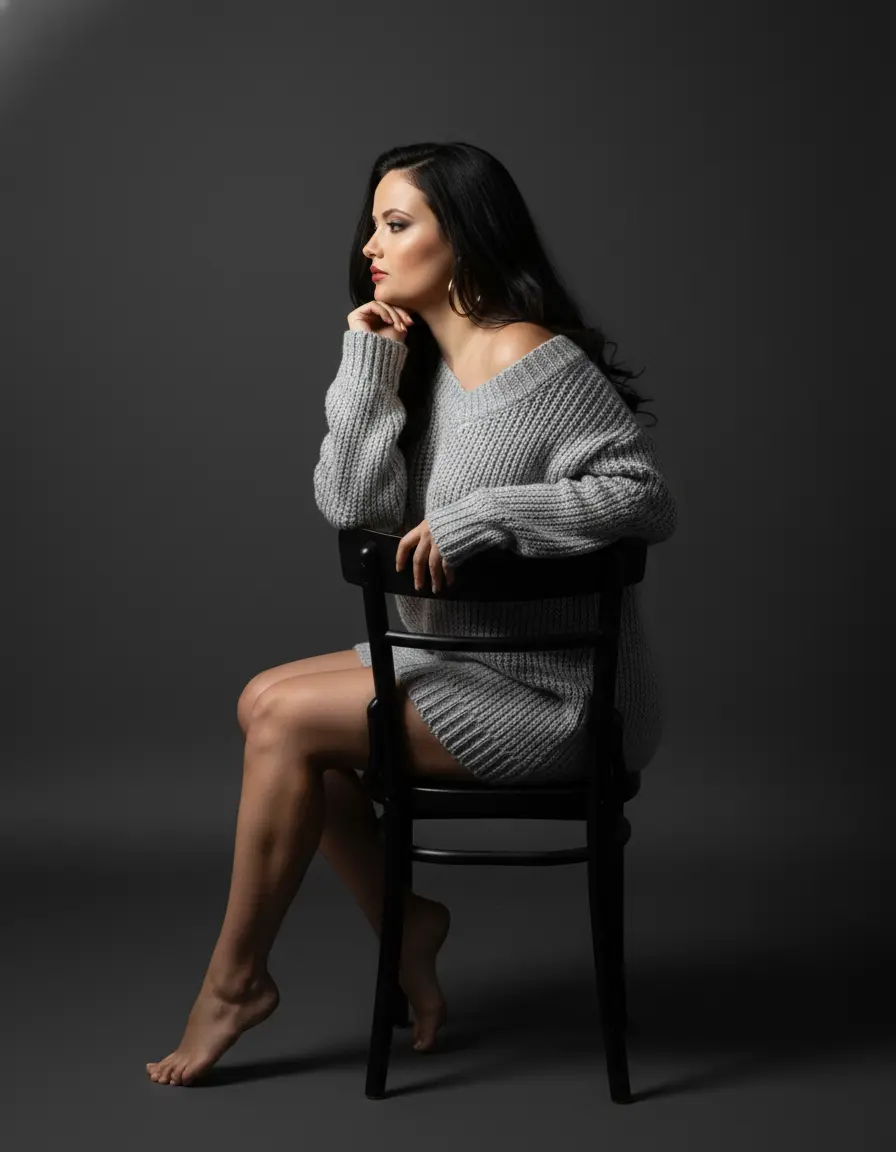
The Sweater Portrait Nano Banana Prompt

Published July 14, 2026 · ♥ 66

The Sweater Portrait Nano Banana prompt example

Nano Banana prompt text

A full-length studio photograph with a fine art aesthetic and dramatic lighting. It captures a female figure in a contemplative pose, sitting sideways on a simple black wooden chair. Her face is in profile, looking out of the frame, with one hand elegantly resting on her chin. The other hand rests on the back of the chair. She wears an oversized, off-white or light gray knit sweater, worn casually with the shoulders off, covering her torso like a short dress and revealing her legs. Her feet are bare. Her hair is long, dark, and voluminous, with natural waves falling over her back and one shoulder. The background is a minimalist studio backdrop in a dark gray or deep, uniform brown. Lighting is the key element: a low-key, sculptural scheme (like Rembrandt or Chiaroscuro), with a single main light source (softbox) positioned to the side. This creates a dramatic contrast, illuminating one side of the figure and leaving the other side in soft, deep shadows, highlighting the shape and texture of the skin and sweater. Camera Settings: Captured with a prime portrait lens (e.g., 85mm or 100mm) on a full-frame camera for flattering compression. Aperture set between f/4.0 and f/5.6 to ensure sharpness on the face and body, with a shallow depth of field that isolates the subject. ISO 100-200. Shutter speed 1/160s to 1/250s. Studio lighting controlled with a gridded softbox to direct the light and deepen the shadows. Instructions for the "nano banana": "Please use the user's reference image to capture and apply all of their facial features, facial structure, eye color, skin tone, style, and hair color with maximum fidelity. The goal is to create a version of the user in this artistic portrait. The clothing (oversized sweater), the contemplative pose on the chair, the bare feet, the low-key dramatic lighting, and the dark studio background should be generated as described, creating a perfect fusion between the user's identity and the aesthetic of the image."
CinematicFashionPhotographyRealisticPortrait

Prompt workflow

How to use this Nano Banana prompt

Start with the full prompt so its subject, scene, and visual direction stay connected. Then adapt only the part that changes your result: the subject for a new concept, the scene for a different setting, or the style and composition for a new format.

Preserve the core brief

Keep the subject, visual style, and composition cues that make this prompt recognizable. Change one creative variable at a time when iterating.

Match the output to the channel

Choose the aspect ratio for the final placement, then add a clear crop, camera, or layout instruction instead of relying on a vague style word.

Use references for hard-to-name details

Upload references when a product shape, material, palette, or composition is easier to show than to describe in words.

Refine with a specific goal

Ask for a concrete change such as a different background, lighting direction, framing, or text treatment while naming the details that must remain.

Use this prompt with other image models

This remains a Nano Banana prompt first. Use these alternatives when the same brief needs a different kind of image control.

Similar Nano Banana Prompts

Explore related visual directions selected from shared tags and popular prompt ideas.

Nano Banana prompt FAQ

How should I adapt this prompt?

Keep the strongest subject, scene, and style instructions, then make one targeted change for the result you need. Clear changes are easier to evaluate than replacing the whole prompt at once.

When should I use a reference image?

Use a reference when you need to preserve a visual detail that text alone may not capture, such as a product silhouette, a material, a color palette, or a composition.

Which model should I choose?

Start with Nano Banana for fast iteration. Choose GPT Image 2 for text-heavy or precise edit requests, and Flux 2 Pro when detailed commercial art direction or multiple references matter most.